
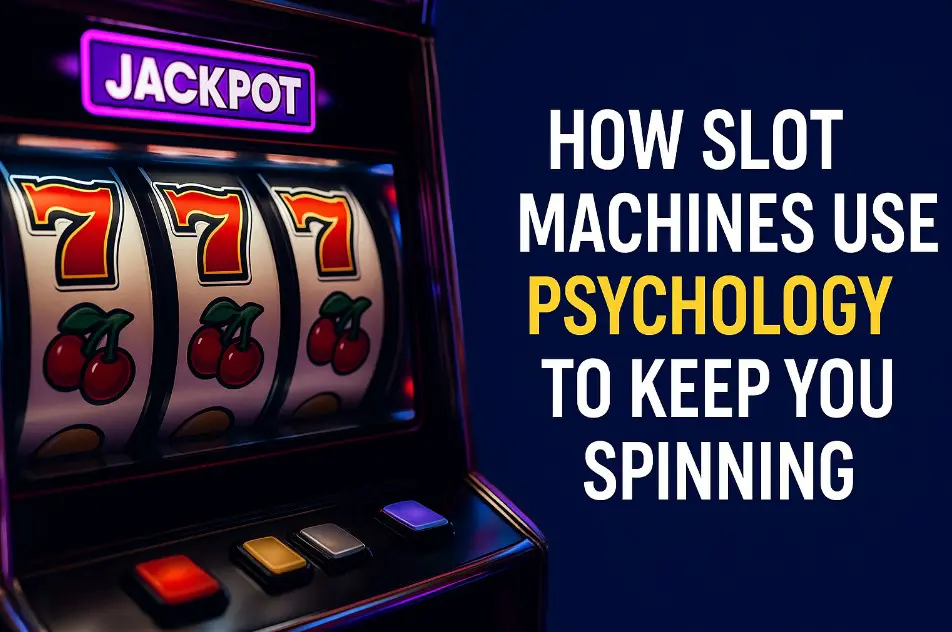
You can hear it before you even step onto the casino floor — that bright, chaotic melody of clinking coins, spinning reels, and overexcited jingles. Somewhere in there, someone’s laughing. Someone else is hunched forward, convinced the next spin has to be the one. Slot machines aren’t just games; they’re finely tuned psychological devices. And honestly, they’re kind of brilliant.
Every light flash, every near win, every “big win” sound (even when it’s not that big) — it’s all designed to mess gently, almost playfully, with the human brain. And if you’ve ever found yourself saying “just one more spin,” you’ve already met the psychology behind it.
How Psychologists Shaped the Modern Slot Machine
Slot machines might look like shiny entertainment boxes, but they’re actually small behavioral experiments dressed up in sequins. The core idea goes back to the 1950s, when psychologist B.F. Skinner was teaching pigeons to peck a lever for food. The trick? He didn’t feed them every time. Only sometimes. Randomly. The pigeons went wild for it.
That’s called operant conditioning — rewarding behavior at unpredictable intervals. Humans aren’t so different. Swap the pigeon for a player, the lever for a spin button, and the food pellet for a cash prize, and you’ve basically got a slot machine. Every pull of the lever (or tap on your phone) is a little act of hope.
Casinos learned quickly that unpredictability is addictive. Not the win itself — but the maybe. It’s that electric in-between feeling, when the reels slow down and you lean in slightly, half-holding your breath.
The Rhythm of Reward: Why Uncertainty Hooks Us
If you’ve ever fed coins into a slot, you’ve felt it — that little pulse of anticipation. Each spin is a miniature suspense story. You act, the reels spin, and your brain braces for feedback. Maybe you win, maybe you don’t. The thing is, you never know when.
Psychologists call that a variable ratio schedule — and it’s one of the most powerful reinforcement systems ever studied. You keep playing not because you always win, but because sometimes you do. The randomness makes every win feel earned, almost personal.
I once met an old-school slot player who said, “The machine and I have a thing going on. It teases me, I tease back.” He wasn’t joking. That teasing — the uncertainty — is what keeps people glued to their seats.
The Near-Miss Effect: Losing That Feels Suspiciously Like Winning
Picture this: you’ve got two jackpot symbols lined up, and the third one clicks into place just above the payline. So close you can almost taste it. You laugh, maybe curse a little, and hit spin again. That feeling? That’s the near-miss effect.
Our brains treat near misses like almost-wins. Neurologically, they light up the same reward circuits as actual victories. It’s wild. Even when we lose, our dopamine system gives us a little pat on the back and whispers, “You were so close — go again.”
Game designers know this, of course. Near misses aren’t random; they’re built into the experience. Every time those reels stop just shy of glory, your brain files it as progress, even though RNGs (random number generators) don’t have memory. The machine doesn’t know you’re “due” — but your brain sure thinks you are.
The Illusion of Control: When Choice Feels Like Power
Ever stop the reels manually because you knew it would land better that way? Yeah. We’ve all done it. That’s what psychologists call the illusion of control — believing our actions influence outcomes that are, in reality, completely random.
Slots are full of fake agency: tapping buttons, selecting paylines, choosing when to stop the reels. It’s like being handed the wheel of a self-driving car. You feel involved, but the system’s already decided your fate.
Still, it works. Players who interact more often — even if their choices don’t matter — tend to stay longer and feel more satisfied. It’s participation theatre, but the human brain loves a good performance.
When the Mind Starts Playing Tricks: Cognitive Biases at Work
The human brain is an incredible pattern-seeking machine, and slot games feed that instinct like candy. You start spotting shapes, rhythms, or lucky streaks that don’t actually exist.
The gambler’s fallacy is a classic one: after a dozen losing spins, you start believing a win must be coming soon. You’re wrong, of course, but your intuition doesn’t care. It’s whispering, “It’s about time.”
Then there’s the availability bias. You see a jackpot celebration flash across the casino floor — bells ringing, coins spilling, confetti raining down — and suddenly it feels like everyone is winning except you. You overestimate your odds based on what’s most vivid in your mind. The casino makes sure those big wins are very visible.
Honestly, it’s clever psychology. Casinos don’t lie. They just let your brain do the storytelling.
Sound, Color, and Emotion: The Subtle Art of Slot Seduction
Spend five minutes near a bank of slots and you’ll realize how sensory it all is. The sounds are warm and sparkly, the lights pulse in comforting rhythm, and even losing feels… surprisingly pleasant.
Designers know exactly what they’re doing. Wins are paired with bright, high-pitched tones that make you feel uplifted. Losses? Muted, neutral jingles that soften the disappointment. Sometimes you “win” less than you bet but still get celebratory sounds — a trick researchers call losses disguised as wins. It’s like being congratulated for losing politely.
Color matters too. Gold and red signal excitement and luxury, while blues calm you down just enough to keep you spinning longer. One developer once said that designing slots was “part math, part music, part mood lighting.” Honestly, that sums it up pretty well.
Dopamine: The Real Jackpot
If you could peek inside your brain mid-game, you’d see dopamine firing like fireworks. But here’s the twist — it’s not the winning that spikes dopamine. It’s the anticipation. The “maybe I’ll win this time” moment.
Over time, the brain starts craving that anticipation itself. That’s why even losing can feel exciting — it’s the chase, not the catch. In long-term players, dopamine systems actually adapt, needing more stimulation for the same emotional payoff. It’s eerily similar to what happens in substance addiction.
That’s the scary beauty of slot design: it turns uncertainty into chemistry. You’re not chasing money. You’re chasing a feeling your brain keeps promising and never quite delivering.
How Game Design Keeps You Coming Back
 Slot developers think about retention as much as rewards. They use psychological scaffolding — progress bars, near-wins, unlockable bonuses — to make you feel like you’re building toward something.
Mobile slots took this even further with daily spins, loyalty badges, and “collect all symbols” missions. It’s the same system that keeps people checking social media apps compulsively. Every little nudge says, “Don’t leave yet — you’re almost there.”
And yes, even the sounds evolve. The longer you play, the more the music builds in intensity, subtly suggesting momentum. I once timed a friend’s session, and sure enough, as he neared an hour, the soundscape shifted from playful to epic. It felt like he was approaching something monumental. He wasn’t — but his brain didn’t care.
Here’s what really keeps players in the loop:
- Small, frequent wins that keep dopamine active
- Emotional highs from near misses and sensory drama
- Visible jackpots that trick your sense of possibility
- Bonus rounds that offer fake control and suspense
- Progress systems that mimic “achievement” in gaming
It’s not gambling anymore — it’s engagement architecture.
Common Myths and Half-Truths About Slot Psychology
People love to think there’s a secret code. That certain machines are “hot,” or that timing your spins just right boosts your odds. I hate to break it to you, but slots have no memory, no mood, no grudges. Each spin is as random as a coin toss.
The math behind it — the RNG, or random number generator — ensures complete unpredictability. What’s not random is the presentation: how often you see a near-miss, how wins are displayed, how lights flash at the perfect moment. The manipulation lives in the experience, not the math.
There’s also this myth that “smart” players can spot payout cycles. Nope. Every spin resets the story. The only “cycle” happening is in your brain.
When Design Crosses the Line
Here’s the ethical gray area: at what point does good design become manipulation? Slot machines don’t force you to play, but they make it very, very hard to stop. The balance between fun and exploitation is a thin one — thinner than most players realize.
Some casinos have started building in “reality checks,” like pop-ups reminding you how long you’ve been playing. Others restrict autoplay or require visible win/loss displays. It’s a step, but let’s be honest — self-awareness is the only real countermeasure.
If you understand how these psychological tricks work, you can see them happening in real time. And when you see the strings, it’s a lot easier not to get pulled.
Playing With Your Eyes Open
There’s nothing wrong with spinning a few reels for fun. It’s when the machine starts playing you that the trouble begins. Knowing about the near-miss effect, the illusion of control, the dopamine loop — it all gives you a small edge. A mental buffer.
Next time you’re at a casino, watch yourself. Notice the moment your heart jumps when two symbols align. Notice how the lights change when you lose. It’s fascinating when you realize what’s really going on under the hood.
Because the real jackpot isn’t the flashing number on the screen. It’s awareness — that rare, satisfying moment when you can enjoy the game without being tricked by it.